

Contacted by Police About a Sex Crime in Arizona? Do Not Say a Word Without a Defense Attorney
By Michelle Skura, Esq. | Felony Sex Crime Defense Attorney
The phone rings. It is a detective. The detective is calm, even friendly, and tells you there has been a complaint and just wants to hear your side of the story so the case can be closed. You are assured that this is routine, that you are not in trouble, and that cooperating is the best thing you can do. The detective may even suggest that hiring a lawyer would make you look guilty.
Do not believe any of it. Do not meet with the detective. Do not answer their questions. And do not say a single word about the allegations without your defense attorney present.
At VS Criminal Defense Attorneys, we have represented hundreds of individuals accused of sex crimes across Arizona. One of the most damaging things we see, over and over again, is a well-intentioned person who spoke with police before calling us. In nearly every case, those statements were used to build the case against our clients, not to help them. The decisions you make in the hours and days after law enforcement first contacts you may be the most consequential of your life. Your right to remain silent, your constitutional protections, and the immediate retention of experienced legal counsel are what stand between you and the permanent loss of your freedom and your future.
You May Not Even Know You Are Being Investigated
One of the most alarming realities of sex crime accusations in Arizona is that an investigation can be well underway long before the accused person has any idea a sex crime investigation is<<already being conducted against them. Police and detectives spend days, weeks, or sometimes even months conducting interviews, gathering digital evidence, and reviewing records before ever reaching out to the person being accused.
By the time a detective makes that first friendly, low-pressure phone call requesting a conversation, law enforcement has typically already spoken with the alleged victim, documented their account, and formed a working theory of what happened. The detective who calls you is not starting an investigation. The investigation began the moment the complaint was filed with law enforcement.
Prior to retaining our services, many of our clients had no idea that an active sex crime investigation had already been opened against them. That first call to our office is often the moment the full picture becomes clear. They did not know a report had been filed. They had no idea there was even a complaint. But the absence of prior warning does not mean the investigation is in its early stages. It may mean that law enforcement has already gathered substantial evidence against you, and that a statement from you is the final piece detectives believe they need to advance the case toward arrest and formal prosecution.
What Police Are Really Seeking When They Say They “Just Want To Talk”
Law enforcement is skilled at making initial contact feel informal and non-threatening. Detectives are trained in psychological tactics designed to lower your defenses, gain your trust, and encourage you to speak freely. Common phrases you may hear include:
- “We just need to get your side of the story.”
- “This is your chance to clear your name.”
- “If you cooperate now, this will go much easier for you.”
- “You are not under arrest. You do not even have to come in.”
- “We can probably clear this whole thing up today.”
- “I’m ready to close this case. I just need your statement.”
These statements are not lies in a technical sense, but they are deeply misleading. What the detective does not tell you is that anything you say, every word, every denial, every explanation, will be documented, analyzed, and potentially used as evidence against you. Even truthful, well-intentioned statements can be mischaracterized. Even partial information you provide to fill in a gap can inadvertently corroborate the accuser’s version of events.
The detective is not your advocate. The detective is the instrument of the State’s effort to build a case against you. The moment law enforcement contacts you in connection with a sex crime investigation, you must treat the situation with extreme caution.
Law Enforcement Has Already Decided You Are Guilty
This is a difficult truth, but it is one our clients need to hear: by the time a detective contacts you, law enforcement has almost certainly already concluded that a crime occurred and that you are responsible. The investigation to that point has been driven entirely by the accuser’s account. The detective’s role, at the stage of contacting you, is not to evaluate whether you are guilty. It is to gather additional evidence to support the case law enforcement is already building against you.
In the world of Arizona sex crime defense, the accused is frequently treated as guilty from the outset. Allegations of sexual misconduct carry enormous weight, and law enforcement agencies across Maricopa County and Pinal County, serving communities including Phoenix, Mesa, Gilbert, Scottsdale, Tempe, Chandler, Glendale, Peoria, and Queen Creek, operate under significant institutional pressure to pursue sex crime allegations aggressively. Factor in the specialized training detectives receive in securing statements, and you have a situation where the odds are stacked heavily against anyone who chooses to speak with police without a defense attorney present.
Your words, even if they are truthful and innocent in intent, will be filtered through the detective’s preexisting belief in your guilt. Statements that you believe are exculpatory will be reframed. Gaps in your memory or timeline will be characterized as evasiveness or deception. Anything that touches on the accuser, the alleged incident, or your relationship with the complaining party will be weaponized when the opportunity arises.
You cannot win a conversation with law enforcement under these circumstances. The only protected response is to invoke your right to remain silent and request your defense attorney.
Your Constitutional Rights: The Fifth and Sixth Amendments
You have powerful, constitutionally guaranteed rights that exist for precisely this situation. These are not technicalities or loopholes. They are foundational protections embedded in American law to ensure that individuals are not compelled to participate in self-incrimination and their own prosecution.
The Fifth Amendment: The Right To Remain Silent
The Fifth Amendment to the United States Constitution guarantees that no person shall be compelled in any criminal case to be a witness against themselves. This is your absolute right to remain silent. The right to remain silent applies before you are arrested. It applies when a detective calls you on the phone. It applies when officers show up at your home or your place of work. It applies at every stage of the process.
You do not need to be read your Miranda rights for this protection to apply. You are not required to explain yourself, justify your actions, provide an alibi, or correct the detective’s assumptions. The moment a detective or police officer contacts you in connection with a sex crime investigation, you should invoke your right to remain silent clearly and firmly.
The correct response is simple: “I am exercising my right to remain silent. I would like to speak with my defense attorney before answering any questions.”
Then, stop talking. Do not elaborate. Do not soften the statement. Do not apologize. Simply say those words and say nothing further.
The Sixth Amendment: The Right To Legal Counsel
The Sixth Amendment guarantees your right to have the assistance of an attorney in your defense. This right attaches at the onset of formal adversarial proceedings, and while the legal technicalities of exactly when it applies can be complex, the practical message is this: you have the right to have a defense attorney by your side, and no law enforcement officer can legally prevent you from exercising your constitutional right to counsel. The Arizona Constitution, Article 2, Section 24, reinforces this right at the state level as well.
Importantly, exercising your right to counsel cannot be used against you as evidence of guilt in a court of law. A prosecutor cannot stand before a jury and argue that your decision to hire a defense attorney proves you had something to hide. Asserting your constitutional rights is not a confession. It is the exercise of a protection that the legal system explicitly provides you.
What Happens If You Avoid Police Contact
Many people who receive an initial call from law enforcement try to manage the situation by simply not responding. They avoid the detective’s calls, do not return messages, and hope the matter resolves on its own. We understand this impulse completely. When facing something this frightening and unexpected, the instinct is to avoid confrontation and put distance between yourself and the situation. Unfortunately, avoidance without legal representation does not create distance. It creates vulnerability, because the investigation continues moving forward while you remain completely unprotected and uninformed.
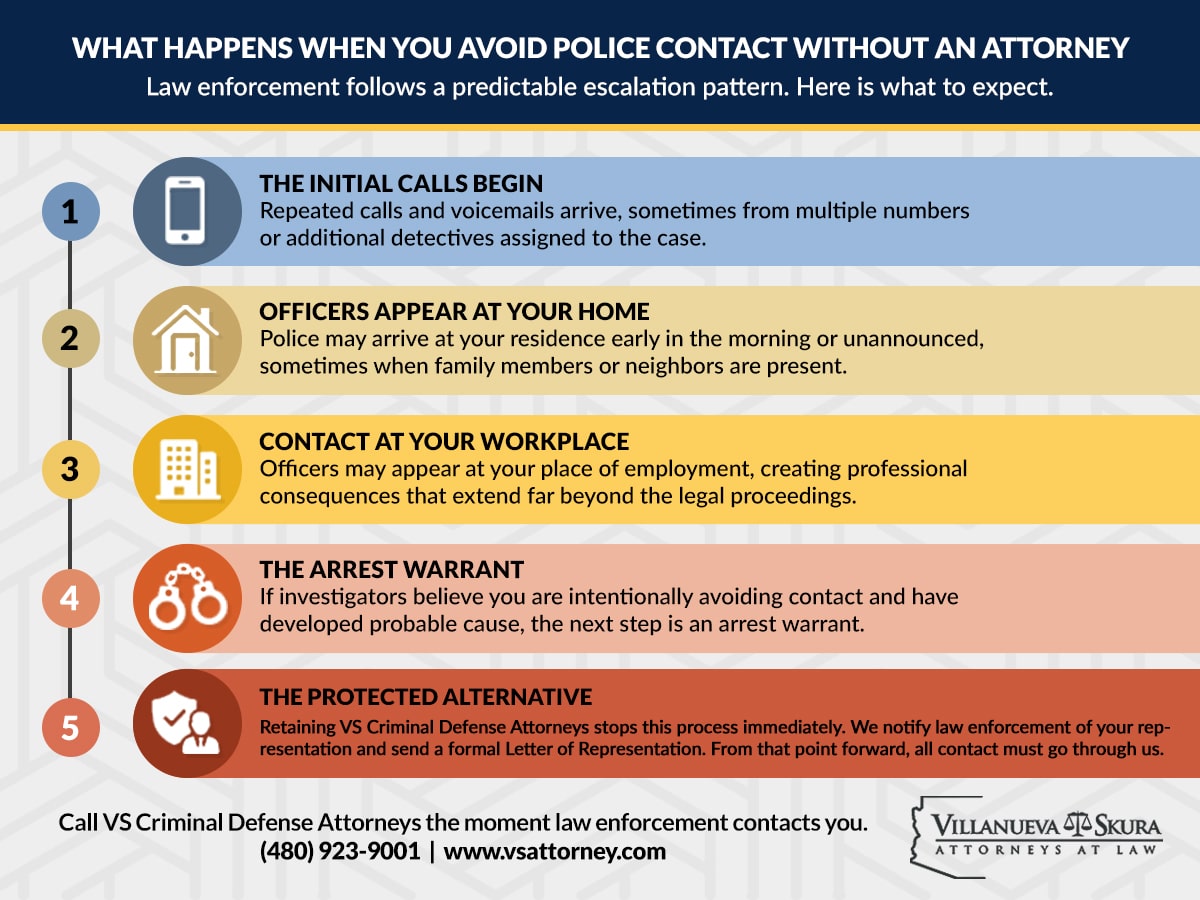
In our experience at VS Criminal Defense Attorneys, law enforcement does not simply move on when initial contact is avoided. Instead, the approach escalates in a predictable pattern:
The Initial Calls: Repeated phone calls and voicemails begin arriving, sometimes from multiple numbers or additional detectives assigned to the case.
Officers at Your Home: Police may show up at your residence, sometimes early in the morning, sometimes when family members, roommates, or neighbors are present and watching.
Officers at Your Workplace: Officers may make contact at your place of employment, which can have devastating professional consequences entirely apart from anything happening in the legal proceedings.
The Arrest Warrant: In some cases, if investigators believe you are intentionally avoiding police contact and they have developed sufficient probable cause, the next step is an arrest warrant.
Avoiding police contact without the protection of a defense attorney does not make the problem disappear. It simply allows the sex crime investigation to continue building against you while you remain exposed. The moment you retain VS Criminal Defense Attorneys, we take immediate action on your behalf. We contact the investigating detective or officer directly to formally notify law enforcement that you are now legally represented and that all further communication must be directed through our office. We also send a formal Letter of Representation to the investigating agency, creating an official legal record of your representation and establishing that any attempt to contact you directly is no longer appropriate. From that point forward, law enforcement is legally required to go through VS Criminal Defense Attorneys.
Your Attorney Becomes Your Shield
The moment you retain VS Criminal Defense Attorneys, everything changes. Under Arizona law, once investigators are notified that you have retained legal counsel, they are required to direct all further contact through your defense attorney. The calls stop coming to your personal phone. The officers stop appearing at your door. Your employer does not receive a visit from law enforcement.
This is one of the most immediate and powerful benefits of early legal intervention, and it is one of the primary reasons we urge anyone who has been contacted by law enforcement in connection with a sex crime to call us before doing or saying anything else.
Beyond simply stopping police contact, your defense attorney works proactively during the pre-charge and pre-indictment phase to protect your position. This includes:
Preserving Evidence: Critical evidence that supports your defense, including text messages, emails, surveillance footage, and witness accounts, can disappear quickly. Your defense attorney knows what to preserve and how to obtain it before it is lost.
Preventing Charges From Being Filed: Depending on the specific circumstances of the case, meaningful intervention during the pre-file stage can prevent formal criminal charges from ever being filed. There is a narrow window during which an experienced sex crime defense attorney can present information to a prosecutor that causes the prosecutor to decline to charge the case. Once criminal charges are filed, that opportunity is gone.
At VS Criminal Defense Attorneys, we represent individuals facing the full range of felony sex crime allegations in Arizona, including sexual assault, sexual abuse, rape, molestation, sex stings, sex trafficking of a minor, luring a minor for sexual exploitation, dangerous crimes against children, and indecent exposure. Regardless of the specific charge or allegation being investigated, the guidance throughout this article applies without exception: do not speak with law enforcement without your defense attorney present.
The Danger of Trying To “Explain” Your Way Out
We cannot count the number of times we have sat across from a client who told us, with absolute sincerity, that they thought they could clear things up by just talking to the detective and explaining what really happened. They went in with good intentions. They told the truth. And the detective still used their words against them.
Here is why this happens: the interrogation room is not a neutral space, and the detective is not a neutral listener. Detectives are trained in interrogation techniques designed to elicit statements that support the case law enforcement is building against you. Detectives know how to ask questions in ways that lead you to confirm their assumptions. They know how to use silence and strategic follow-up to encourage you to keep talking until you say something that can be used against you.
Even an entirely truthful account of events can be devastating in the wrong context. Minor inconsistencies, the kind that exist in any honest person’s recollection, become evidence of deception in the hands of a skilled prosecutor. Details that you choose to include or leave out are scrutinized by investigators for signs of guilt. Statements that you believe are complete denials can, with careful selection and editing by prosecutors, be presented to a jury in ways that bear little resemblance to what you actually intended.
The single most protective step you can take for yourself in a sex crime investigation is to say nothing, exercise your constitutional rights, and let your defense attorney speak for you.
FAQ: What To Do If Police Contact You About A Sex Crime In Arizona
What should I say if a detective calls me and asks me to come in for questioning?
Invoke your right to remain silent and your right to a defense attorney immediately, then end the call.
You should say exactly this, and nothing more: “I am invoking my right to remain silent and my right to a defense attorney. Please contact my attorney, Michelle Skura, at (480) 923-9001.” Then end the call. Do not explain yourself. Do not ask questions. Do not agree to meet at a later date. Simply invoke your rights and hang up.
What if I am completely innocent? Will speaking with police help clear my name?
No. Innocence alone does not protect you from a well-executed police interrogation, and speaking with detectives without a defense attorney present can seriously damage your case regardless of the truth.
This is the most common misconception we encounter. Even truthful statements can be misrepresented by detectives, taken out of context, or used to fill in gaps in the State’s narrative. The safest course for an innocent person is the same as for anyone else: remain silent and hire an experienced sex crime defense attorney.
What if police show up at my home or work?
You are not required to speak with police officers under any circumstances, and you should not do so without your defense attorney present.
Step outside if they knock, or simply speak through a partially opened door. You can say: “I am not answering any questions without my defense attorney present. Please contact my attorney.” Then call us immediately at (480) 923-9001. Do not allow officers inside your home without a warrant.
Will refusing to cooperate with police make me look guilty?
Refusing to speak with police is a constitutionally protected right and cannot legally be used as evidence of guilt in a criminal proceeding.
To the detective, perhaps it will appear that way. But the detective is not the decision-maker in your case. A judge and jury are. Far more damaging than a refusal to speak with police is a poorly worded, emotionally charged statement made without the benefit of your defense attorney.
Can police arrest me just because I refuse to cooperate?
No. Refusing to speak with police, by itself, is not a legal basis for arrest.
Law enforcement must have probable cause to arrest you, which is a legal standard that your silence alone cannot satisfy. If investigators have sufficient evidence to arrest you, they can do so regardless of whether you cooperate. Cooperation does not prevent an arrest, but it can provide additional evidence that makes prosecution easier.
I was contacted by police about an alleged sex crime but I had no idea there was even an accusation against me. What immediate steps should I take to protect myself?
Contact a sex crime defense attorney immediately. The investigation may have been underway for weeks or months before law enforcement reached out to you.
The fact that you were unaware of the accusation does not mean the sex crime investigation is just starting. The moment a detective or police officer contacts you, the clock is running. Early legal intervention gives us the best opportunity to protect your freedom before formal criminal charges are filed.
What is the difference between being a suspect and being charged with a sex crime in Arizona?
Being a suspect means law enforcement is investigating you but no formal charges have been filed. Being charged means a prosecutor has made the decision to pursue criminal charges against you in court.
Being a suspect means law enforcement has identified you as a person of interest and is actively investigating your potential involvement in an alleged offense. At this stage, no formal criminal charges have been filed and you have not been arrested. Being charged means the prosecutor has reviewed the evidence gathered during the investigation and made the decision to file formal criminal charges against you, which triggers the official court process.
The period between becoming a suspect and being formally charged is one of the most critical windows in any sex crime case. It is during this pre-charge phase that a defense attorney can intervene, challenge the strength of the evidence, and in some cases present information to the prosecutor that causes the case to be declined before it ever reaches the public record. Retaining a defense attorney the moment you become aware that law enforcement is investigating you is the most effective way to take advantage of that window.
Can a detective lie to me during a sex crime investigation in Arizona?
Yes. Under current United States law, law enforcement officers are legally permitted to use deception during an investigation and interrogation.
A detective can tell you that a co-worker identified you, that physical evidence has already confirmed your guilt, that the alleged victim passed a polygraph examination, or that cooperating now will result in more favorable treatment, even if none of those statements are true. These tactics are specifically designed to pressure you into making statements or admissions that can then be used against you in court.
This is one of the most important and least understood realities of any sex crime investigation in Arizona. Many individuals who speak with detectives do so because they believe the detective is being straightforward with them. In reality, the detective may be constructing an entirely false narrative designed to provoke a reaction, elicit a confession, or simply get you talking. Once you begin talking, it becomes very difficult to stop without appearing evasive or guilty.
The only protection against deceptive interrogation tactics is to invoke your right to remain silent and request your defense attorney the moment law enforcement contacts you. A detective cannot lie to your defense attorney about the state of the evidence in a formal legal context the way a detective can lie to you in a casual conversation or during an interrogation.
What happens if I am arrested for a sex crime in Arizona after speaking with police?
If you spoke with police before retaining a defense attorney, those statements are now part of the official record and can be used against you at every stage of the prosecution.
An arrest following a police interview is particularly serious because the statements you made are now in the hands of prosecutors who will use them to build and strengthen their case. At this point, retaining an experienced sex crime defense attorney immediately is critical. While the opportunity to intervene during the pre-charge phase has passed, a skilled defense attorney can still challenge the admissibility of your statements, scrutinize how law enforcement conducted the investigation, and build the strongest possible defense on your behalf. The lesson for anyone who has not yet spoken with police is clear: do not wait until after an arrest to seek legal counsel. Contact VS Criminal Defense Attorneys the moment law enforcement reaches out to you.
Does this advice apply if I am being investigated for sexual assault, a sex sting, sex trafficking, or luring a minor in Arizona?
Yes. The constitutional right to remain silent and the right to retain a defense attorney apply to every category of sex crime investigation in Arizona without exception.
Whether law enforcement is investigating an allegation of sexual assault, sexual abuse, rape, molestation, a sex sting operation, sex trafficking of a minor, luring a minor for sexual exploitation, dangerous crimes against children, or indecent exposure, the fundamental guidance remains the same. Do not speak with detectives or police officers without your defense attorney present. The specific nature of the allegation does not change the risk that voluntary statements pose to your case. In fact, certain categories of sex crime investigation in Arizona, particularly sex stings and cases involving alleged victims who are minors, involve highly specialized investigative tactics that make speaking with law enforcement without a defense attorney even more dangerous. At VS Criminal Defense Attorneys, we have extensive experience defending individuals against the full range of felony sex crime charges throughout Maricopa County and the greater Phoenix metro area.
What happens after an arrest for a sex crime in Maricopa County, Arizona?
After an arrest for a sex crime in Maricopa County, you will be taken to an Initial Appearance hearing within 24 hours, where a judge will inform you of the charges, determine probable cause, and set release conditions including bail or bond.
In Maricopa County, this hearing takes place at the Intake Transfer and Release facility, commonly known as the ITR, located in Phoenix. The ITR operates 24 hours a day, seven days a week, which means an arrest made in the afternoon can result in a court appearance before a judge at midnight. Following the Initial Appearance, if bail is posted or the defendant is released on recognizance, the case proceeds toward arraignment in Maricopa County Superior Court, where a formal plea is entered and future court dates are assigned.
Having a defense attorney present at the Initial Appearance is critical. Without experienced legal representation at this stage, defendants frequently face unreasonably high bail amounts and restrictive release conditions that can be difficult or impossible to modify later. At VS Criminal Defense Attorneys, our attorneys appear regularly at the ITR facility on behalf of clients facing felony sex crime charges in Maricopa County. For a detailed explanation of what to expect at Initial Appearance Court, we encourage you to read our dedicated article on Initial Appearance Court for Sex Crime Charges in Arizona.
Why Choose VS Criminal Defense Attorneys?
Your freedom and your future are too important to leave to a firm that does not specialize in the criminal defense of sex crimes. Michelle Skura, Esq. and the team at VS Criminal Defense Attorneys provide discreet, aggressive, and strategic defense for individuals facing serious sex crime allegations throughout the Phoenix metro area, including Mesa, Gilbert, Scottsdale, Tempe, Queen Creek, Chandler, and Phoenix.
If law enforcement has contacted you, or if you have any reason to believe you may be under investigation for a sex crime, do not wait. Do not speak with police. Call us first.
Contact VS Criminal Defense Attorneys today for a confidential consultation at (480) 923-9001 or visit us at www.vsattorney.com.
About The Author: Michelle Skura, Esq.
Michelle Skura, Esq. is the lead attorney and owner of VS Criminal Defense Attorneys. With an exclusive focus on felony sex crimes in Arizona, she is a passionate advocate for individual rights and constitutional accountability. Recognized as a Top 100 Criminal Defense Attorney by the National Trial Lawyers, she provides aggressive and strategic representation to ensure that every client’s voice is heard and their rights are fully protected at every stage of the process.
Legal Disclaimer: The information provided in this article is for general informational purposes only and does not constitute legal advice. No attorney-client relationship is formed by reading this content or contacting the firm through this website. Because the laws surrounding sex crimes are complex and subject to change, you should consult with a qualified attorney regarding the specific facts of your case.

VS CRIMINAL
DEFENSE ATTORNEYS
1845 S Dobson Rd Suite 202
Mesa, AZ 85202
Phone: 480-923-9001
Email: info@vsattorney.com
AZ SEX
CRIMES ATTORNEY
1425 S Higley Rd #101 Unit 2
Gilbert, AZ 85296
Phone: 480-553-9440
Email: info@vsattorney.com
PHOENIX SEX
CRIMES LAWYER
1100 E Washington St Suite 154,
Phoenix, AZ 85034
Phone: 602-805-1212
Email: info@vsattorney.com
ARIZONA FELONY
DEFENSE LAWYER
3919 E Potter Dr
Phoenix, AZ 85050
Phone: 480-933-2329
Email: info@vsattorney.com